
Reduce Heat Pump Noise from Neighbours: 10 to 20 dB Quieter
Heat pump noise nuisance is one of the fastest growing sources of neighbour complaints in Belgium. The outdoor unit produces a continuous, low-frequency humming sound that penetrates walls and windows and disrupts sleep. At Noise Solutions in Beveren-Kruibeke-Zwijndrecht, we solve this with acoustic shields, sound-absorbing panels, and, where necessary, a complete enclosure. Our approach typically reduces noise by 10 to 20 dB, follows the official Code of Good Practice from the Flemish Department of Environment (September 2024), and considers the applicable noise standards at the property line. Request a free on-site assessment and noise measurement.
How does a heat pump or air conditioner work? The airflow explained
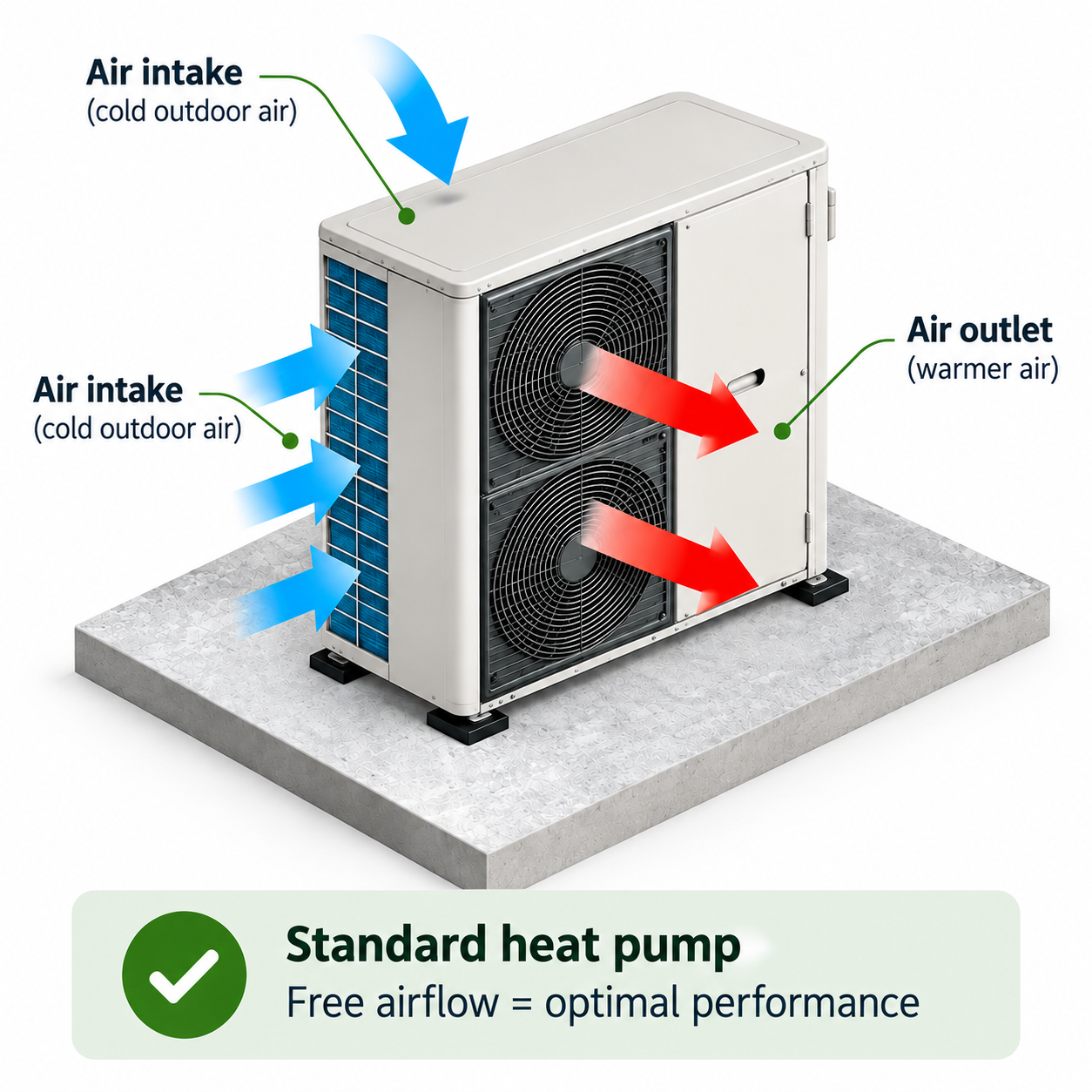
A heat pump or air conditioner with an outdoor unit is essentially a machine that moves heat between your home and the outdoor air. The outdoor unit draws in ambient air, passes it along a coil containing refrigerant, and blows the air back out. In heating mode, the system extracts heat from the outdoor air and brings it inside. In cooling mode, the reverse happens: heat is removed from the home and released to the outdoor air. The side where air is drawn in is called the air intake; the side where air leaves the unit is the air outlet. Both sides must remain unobstructed. When the intake or outlet is blocked, heat recirculation occurs, the compressor works harder, and noise can increase.
- The outdoor unit draws in outdoor air via the fan (air intake)
- The air exchanges heat with the refrigerant in the coil
- When heating: heat from the outdoor air is pumped inside; the discharged air is colder
- When cooling: heat from the home is discharged outside; the discharged air is warmer
- Air intake and outlet must remain unobstructed for efficiency, lifespan, and an acceptable noise level
Why an L- or U-shaped screen often works better than a closed enclosure
A closed enclosure around the outdoor unit sounds like a logical solution, but it often blocks exactly what the unit needs: free airflow. The intake receives warm exhaust air back, the compressor runs harder, and the noise can actually be amplified by reflection inside the enclosure. An acoustic screen in an L or U configuration does interrupt the direct sound path to the neighbours, while the back, sides, and top of the unit remain open. As a result, the unit retains its cooling, capacity, and standard noise level. Noise Solutions designs these screens to measure, based on the installation, the direction of the nuisance, and the Flemish property line standards.
- A closed enclosure can trap warm air and cause recirculation
- L and U configurations interrupt the sound path to the property line without hindering the airflow
- The unit retains its efficiency and does not run harder than necessary
- Reflection of noise back towards the unit is avoided
- The solution is inspectable, demountable, and suitable for maintenance
Heat pump noise nuisance: what are your options?
Heat pump noise nuisance occurs in three scenarios. Each calls for a specific approach that fits within the Flemish Code of Good Practice:
- It is your own heat pump or airco and the neighbours are complaining: have an acoustic analysis carried out and tackle the problem proactively before a formal complaint or notice of default
- Airco noise nuisance from your neighbours or a humming heat pump next door: know your rights, request a noise measurement at the property line, and take the right legal steps
- You are planning a new heat pump or airco installation: prevent noise nuisance through correct placement, vibration damping, and preventive shielding from day one
Legal Noise Standards for Heat Pumps in Flanders
According to the Code of Good Practice, the noise from a heat pump or airco at the property line (measured at a height of 1.5 m) has a guideline value of a maximum of 45 dB(A) during the day (7 am-10 pm) and 40 dB(A) at night (10 pm-7 am). The noise is also measured at the level of opening windows of neighbouring properties. If this standard is exceeded, a neighbour can file a complaint with the municipality or environmental inspection, and the owner is obliged to take measures.
- Daytime (7 am-10 pm): max. 45 dB(A) at the property line
- Nighttime (10 pm-7 am): max. 40 dB(A) - 5 dB stricter
- Measurement point: property line at 1.5 m height and at opening windows of neighbouring house
- Tonal penalty: +5 dB penalty for audible humming tone (see below)
Why Heat Pumps Cause Such Annoying Noise Nuisance (Tonal Noise)
A heat pump or airco often produces a characteristic, low-frequency hum from the compressor and fan. This "tonal noise" is perceived by the human ear as much more annoying than undifferentiated background noise. Therefore, the Code of Good Practice includes a tonal penalty of +5 dB in the measurement: a unit that produces 42 dB on paper is assessed in practice as 47 dB and thus exceeds the daytime standard. This rule explains why even "quiet" heat pumps still cause complaints.
Our Approach in Accordance with the Code of Good Practice
The Code of Good Practice proposes a clear hierarchy of measures. We combine them depending on your situation:
- 1. Vibration isolation at the source - four dampers and a base that at least approximates the weight of the unit, to prevent structure-borne noise via the facade or roof
- 2. Acoustic shielding - an acoustic barrier between the unit and the property line, the most effective and low-maintenance solution
- 3. Sound-absorbing panels - absorb reflections from facades and in niches
- 4. Enclosure of the unit - last resort, requires proper ventilation to prevent the unit from freezing up or malfunctioning
Start with the right outdoor unit
The sound output of the unit itself already sets the upper bound on possible nuisance. Two values matter: the sound power level (Lw) is a property of the device, the sound pressure level (Lp) is what a meter or neighbour actually hears at a given distance. Both are expressed in dB. Because the human ear perceives low and high frequencies differently, the value is usually corrected to dB(A). Since 26 September 2015, units placed on the EU market must comply with the Ecodesign Directive, which caps the sound power level depending on rated heat output. An Ecodesign-compliant unit can still exceed the Flemish property-line limit if poorly placed or installed close to the boundary.
- Compare objectively in the European Commission EPREL database (eprel.ec.europa.eu), where manufacturers publish Lw values for heat pumps and airco units
- A 3 dB difference is barely audible to the ear, but doubles the acoustic energy and can be decisive at the property line
- Ground-source heat pumps have no outdoor unit and therefore no sound pressure on the environment, an option worth considering for new build or renovation
- A correctly sized unit runs quieter, an undersized unit must run at high speed and an oversized unit cycles on and off with noise peaks
- Ask the installer for the quiet night mode and activate it by default between 10 pm and 7 am
Placement and surroundings: why the same unit annoys one neighbour but not the other
Beyond the unit itself, orientation, distance, and surrounding surfaces largely determine how much sound the neighbour finally hears. Free-field rule of thumb: each doubling of the distance between unit and listener reduces sound pressure by about 6 dB(A). In practice, results vary due to reflection off facades, windows, and smooth canopies.
- Orientation: the front and rear of the unit are usually louder than the sides, point the discharge away from neighbours, terraces, opening windows, and ventilation grilles
- Keep enough distance to bedroom windows and property lines, especially if windows are left open at night or if the facade contains ventilation grilles
- Avoid placing the unit in a corner between two facades or in a niche, reflection can amplify sound pressure by several dB
- Absorbing surfaces below and behind the unit (grass, gravel, vegetation, rough finish) reduce reflection by 1 to 2 dB
- Avoid metal canopies and large glass surfaces directly above or next to the unit, they act as sound reflectors
Multiple units or a roof full of outdoor units
In apartment buildings, retail premises, office buildings, and industrial roofs, multiple outdoor units are often installed together. Sound sources add up logarithmically, not arithmetically. Two concrete examples from the Code of Good Practice:
- Two outdoor units of 40 and 43 dB together produce about 45 dB, not 83 dB
- Five outdoor units of 45 dB each together produce about 52 dB
- A roof with several identical units therefore quickly exceeds the Flemish property-line standard, even when each unit individually complies comfortably with Ecodesign
- For battery parks (BESS), transformers, and clusters on retail roofs, we work with enclosing barriers or a shared enclosure per zone
Preventing structure-borne noise: base, dampers, and pipework
Compressor vibrations travel easily through the support (base, facade, or roof) and through metal pipework into the building, where they are heard and felt as a low-frequency hum. The order of preference follows the Buildwise guidelines (article 2019/02):
- Solid ground (grass or garden) gives the lowest risk of structure-borne noise
- On a stable, rigid base at least as heavy as the unit, to prevent it from vibrating along, light roofs are unsuitable
- Four vibration dampers matched to the weight: the load capacity per damper stays at most 30% above ¼ of the unit weight, and the total capacity of the four dampers at least equal to that weight
- On a facade: if unavoidable, place a concrete tile under the dampers per the manufacturer instructions
- Also fit the refrigerant pipework with vibration-absorbing supports and flexible couplings at wall and ceiling penetrations, otherwise structure-borne noise remains audible indoors through the pipes
What You Can Check Yourself Before Calling Us
Often, part of the noise problem can be solved without structural intervention. Prevention is better than cure. As the Code literally states: "Once a neighbour becomes annoyed by noise, they will always remain focused on it." Therefore, first go through this checklist:
- Activate the quiet night mode of your unit - this often reduces noise by 5 dB or more
- Check if the unit is on four vibration dampers and not directly on the facade or floor
- Have the installation checked for correct sizing: a unit that is too small has to run harder, while a unit that is too large starts up more often with noise peaks
- Remove obstacles (bushes, covers) that hinder air circulation
- Do not place the unit in a corner between two facades, as this amplifies the sound through reflection
Request an On-Site Acoustic Analysis
Every situation is different. The sound pressure depends on the type of unit, the distance to the property line, the existing facades, and the ambient background noise. Our experts visit the site, assess your situation based on the Code of Good Practice, and propose a custom solution for private individuals, HVAC installers, and developers. Request a no-obligation custom quote and prevent a neighbour complaint or a formal notice of default.
More technical background can be found in our guide on how an acoustic wall works and on our page about acoustic panels for businesses and technical installations. For larger industrial installations such as transformers or BESS battery parks we build enclosures based on the same principle, but more heavily dimensioned.
Source: Code of Good Practice for managing noise nuisance from heat pumps and airco units, Flemish Department of Environment, September 2024.
Request your quote today
Our experts will be happy to advise you on the best solution for your situation. Contact us for a non-binding conversation.